Returning to Dublin, Ireland, L. Ron Hubbard researched and developed the exact steps and actions a person should follow to establish a successful Scientology mission anywhere in the world.
He also wrote a book containing simple but powerful precepts that allow anyone improve their life immediately.
In Barcelona, Spain, he conducted additional research, then returned to Washington, DC, where he delivered a series of lectures covering a person's spiritual and material requirements.
He then sailed back to England aboard the "Queen Elizabeth", during which time he wrote a book providing solutions to day-to-day job stress.
After delivering 12 lectures on human problems in London, England, he again returned to Washington, DC.
While delivering more than 130 lectures, detailing solutions to such problems as environmental radiation and the failings of groups, L. Ron Hubbard also ran both the new Washington and London Scientology organizations. During this year, he also found the time to write two more books: Scientology: The Fundamentals of Thought and The Problems of Work.
Having completed the 4th London ACC and the Rehabilitating Power of Choice Professional Course, L. Ron Hubbard scarcely paused in his program to enhance auditor skill. Its next phase was hands-on training on the latest processes, concurrently sending auditors into the field to sharpen their skills. Known as the London Auditors Meeting lectures, here is the development of the most fundamental processes later contained in the book, Scientology: The Fundamentals of Thought—processes to begin the cycle of clearing in any zone. They embrace everything from two-way communication—in particular the most broadly workable technique for a low-level case—to an entire lecture on matching auditing to tone. Here, too, is a definition of havingness in terms of postulates, the relationship of havingness to cognitions and the difference between repair and remedy of havingness. While toward even broader understanding, Mr. Hubbard defined processing as the means to improve the ability to play a game. Moreover, to further equip auditors, he provided the know-how of dissemination, teaching three proven methods for procuring new preclears. Here, then, are the basic and powerful truths on how to increase a being’s ability to create the joy of a true game.
While Fundamentals of Thought stands as an introduction to the subject for beginners, it also contains a distillation of fundamentals for every Scientologist. Here are the in-depth descriptions of those fundamentals, each lecture one-half hour in length and providing, one-by-one, a complete mastery of a single Scientology breakthrough—Axioms 1–10; The Anatomy of Control; Handling of Problems; Start, Change and Stop; Confusion and Stable Data; Exteriorization; Valences and more—the why behind them, how they came to be and their mechanics. And it’s all brought together with the Code of a Scientologist, point by point, and its use in actually creating a new civilization. In short, here are the lectures that make a Professional Scientologist—one who can apply the subject to every aspect of life.
Before the first lecture has finished, you will discover precisely where Man went astray in all previous quests for truth, and gain the overriding viewpoint of an effective Scientologist: looking not inward but outward to the world … and handling others. For this is the Congress that signaled the advance of technology to a breadth of uses across all dynamics and all human problems—from personal to global. Beginning with that “almost mystic” quality of a thetan, the ability to grant life, L. Ron Hubbard lays out application after application of Scientology principles to virtually every type of human activity—from educating youth, to training of workers and even causative means to handle the mounting threat of nuclear weapons. While to provide the means for every Scientologist to make a difference, he unveiled the Personnel Efficiency Course. Describing it as “Man’s brightest hope,” he demonstrates how even a tiny amount of Scientology can transform entire zones of living—rapidly and easily. Here, then, is the definitive Congress on bringing Scientology answers everywhere, including the release of The Problems of Work: Scientology Applied to the Workaday World—and the use of that book by Scientologists to help the everyday worker, to problems of a whole society and the means to revive an entire nation to its previous glory.
With war threatening between the “great powers,” L. Ron Hubbard had just delivered the London Congress on Human Problems. There he had introduced the introductory service, the Personnel Efficiency Course, and had announced The Problems of Work as the course text. In his opening lecture, he conveyed both urgency and need: “Our mission, to a large degree, is an educational mission. And we have just recently learned that we have, contained in our subjects, the entirety of education.” Here, in the 15th ACC, is where he taught the application of simplicity, demonstrating its universal power whether in auditing, education or planetary dissemination. He trained auditors not only on how to audit, but how to communicate data and how to educate, introducing the precursors of Study Technology—Learning Processes—that sliced through complexities like a knife through butter. And given auditors would need organizational know‑how, they concurrently attended evening lectures for instruction on running Scientology groups—a series renowned today as Washington Lectures: Organization and Personnel Efficiency. In sum, Mr. Hubbard had taken a giant stride in outreach, and with ACC students primed for action on the front lines, he declared the 15th American ACC the most successful ever.
The “Cold War” between America and Russia was heating up. And with world leaders demonstrating their “power” to each other, with ever increasing tests of nuclear bombs, they were also creating consequences they couldn’t conceive. For while a nuclear test in Russia may seem to have nothing to do with an auditing session in Florida, when L. Ron Hubbard discovered there was a link—he acted. That is, quite in addition to its obvious physical effects, radiation was slowing processing and clearing. Moreover, it wasn’t just in the geographic locale of nuclear tests, but virtually planetwide. What followed was the call for an “Emergency Congress,” in a location that couldn’t have been more appropriate—the Hall of Nations in Washington, DC, overlooking the White House itself. Whereupon Mr. Hubbard first unveiled his research to find any means of addressing the effects of radiation on the body and his discovery of startling effects of nicotinic acid (niacin). Here’s the full story of what he described as the “educated” vitamin, and the original breakthrough that underlies the technology of the Purification Rundown. Even more, here is the greater story of radiation as not just a present-day problem, but an aberrative factor in practically every incident on the whole track. From that revelation came a flood of breakthroughs applicable to virtually all of life—from the bottom-line solution to psychosis, to new technology for raising a being on the Sub-zero Tone Scale—capable of confronting anything. And that’s just a glimpse of what this Congress contains—bringing solutions to problems as old as time itself, and as current as today’s headlines.
The series recorded in 1956

January–December 1956
Game of OT Lectures - The Remedy of Havingness
16 lectures
The lectures gathered here under the archive's "Game of OT" heading are L. Ron Hubbard's London Auditors' Meeting lectures, a run of weekly evening talks he delivered in London from the first of December 1955 into the middle of February 1956. The Church later issued this material under the title The Remedy of Havingness — Why Games, and the sixteen lectures preserved in this collection, identified by their original London Auditors' Meeting numbering and date codes, belong to that run. The occasion was unusual in his lecture chronology: not a congress and not an Advanced Clinical Course, but a standing meeting of practicing auditors, convened so that the professionals then auditing across Britain could be kept abreast of the newest processes week by week, take them into the field, and return with results.
The moment matters. Hubbard had arrived in London in the autumn of 1955, fresh from establishing the new headquarters in Washington, DC, and had just concluded the 4th London Advanced Clinical Course. He would remain in Britain for roughly five months, consolidating the organization there, bringing its auditors current with two years of rapid technical advance, and working out the methods of dissemination that would carry Scientology to a far wider public. The London Auditors' Meeting was the technical engine of that stay, and what he developed before this audience of working practitioners was condensed within months into Scientology: The Fundamentals of Thought, published in 1956.
The first of the series' two great threads is the one named in its published title: havingness. Across these talks Hubbard takes up the elements of havingness, its definition in terms of postulates, its bearing on cognition and on the ARC triangle, and the working distinction between merely repairing a preclear's havingness and actually remedying it — bringing him to the point where he can have or not have, at his own determinism. Alongside this runs sustained instruction in the auditor's craft itself: the power of genuinely two-way communication as the most broadly workable approach to a difficult case, and the necessity of matching the auditing delivered to the preclear's position on the Tone Scale, the subject of an entire lecture in this collection.
The second thread is games, and it is this that gives the archive's title its sense. Through the winter of 1955–56 the theory of games was emerging as the linchpin of processing: freedom, barriers and purposes as the anatomy of any game; the exact conditions that constitute a game as against a no-game condition; the games a being plays without any longer knowing he is playing them, and what that unknowingness has to do with aberration. The thetan, in this frame, is a player, and the state toward which processing points is the recovered ability to enter, play, and leave games knowingly and at cause — the game of an Operating Thetan. Lectures here on sixth dynamic decisional processing and on games processing applied directly to auditing show the theory being turned into usable technique before the listener's ears.
What one encounters across the series, then, is a working seminar rather than a formal address: Hubbard reasoning aloud with his auditors at the very point where the fundamentals of the subject were being settled. The games line begun in these meetings led immediately into the Application of Games Theory to Processing professional course delivered in London in February 1956, and from there into The Fundamentals of Thought itself. For the student tracing the development of Scientology through the mid-1950s, this series records the weeks in which havingness, communication, and games were drawn together into a single coherent account of why beings are in the condition they are in, and what an auditor can do about it.
February 1956
Application of Games Theory - Hubbard Professional Course Lectures
9 lectures
In February 1956, L. Ron Hubbard delivered a special Hubbard Professional Course in London devoted to a single subject: the exact application of games theory to processing. He had been headquartered in England since the autumn of 1955, consolidating the organizational structure of Scientology in Britain while briefing auditors on the latest technical advances through the 4th London Advanced Clinical Course and the weekly London Auditors' Meetings. Through those months, games had emerged again and again as the factor underlying what auditors were encountering in their preclears, and Hubbard had sketched the framework in his lectures on the remedy of havingness and why games exist. With this nine-lecture course he moved from outline to codification, training professional auditors in precisely how games theory is used in the auditing session.
The course occupies a pivotal place in the chronology of the subject. The view of life it teaches — that livingness is composed of games, each made of freedoms, barriers and purposes — was at that moment being distilled into the work that would appear in September 1956 as Scientology: The Fundamentals of Thought, and much of the substance of that book is heard here first, in full classroom development. The same line of research would carry forward through the year to the Games Congress at Washington, D.C. that Labor Day weekend. What these February lectures supplied was the working bridge between theory and the session: not merely that life is a game, but what an auditor does with that fact when seated across from a preclear.
Across the nine lectures, Hubbard takes up the anatomy of games piece by piece. He examines the seemingly paradoxical datum that a being must have restrictions in order to have freedom, and that barriers — far from being simply aberrative — are the very stuff of problems, interest and livingness. He lays out the three factors that account for a preclear being stuck in a win, and gives his fullest explanation to date of the no-game condition: why a game totally won or totally lost ceases to be a game at all, and what that means for cases. Not-knowingness as a necessary ingredient of any game, the cycle-of-action, mock-ups and their relationship to energy and havingness, the handling of confusion by the stable datum, power of choice, and the question of evaluation and the preclear's own reality all come under examination as elements of the games a thetan is playing — knowingly or otherwise.
Three of the lectures are given over to Six Levels of Processing, the graded program of auditing procedures then in use, covering both its theory and its practical application so that the student could see games theory operating inside each step rather than as an abstraction laid alongside them. In this the course reflects its purpose throughout: these are not congress addresses to a general public but professional instruction, delivered to auditors in training, with the directness and technical detail that setting allows.
What the listener encounters, then, is Hubbard teaching at the level of the practitioner — defining terms, working through the mechanics of games conditions, anticipating the errors an auditor might make, and framing auditing itself as a game in which the auditor's task is to bring the preclear to an awareness of his own barriers and freedoms. The material recorded here did not remain a special course; it passed into the permanent foundation of auditing and into the basic books of the subject, making this series one of the essential records of how the games framework entered Scientology in the first months of 1956.
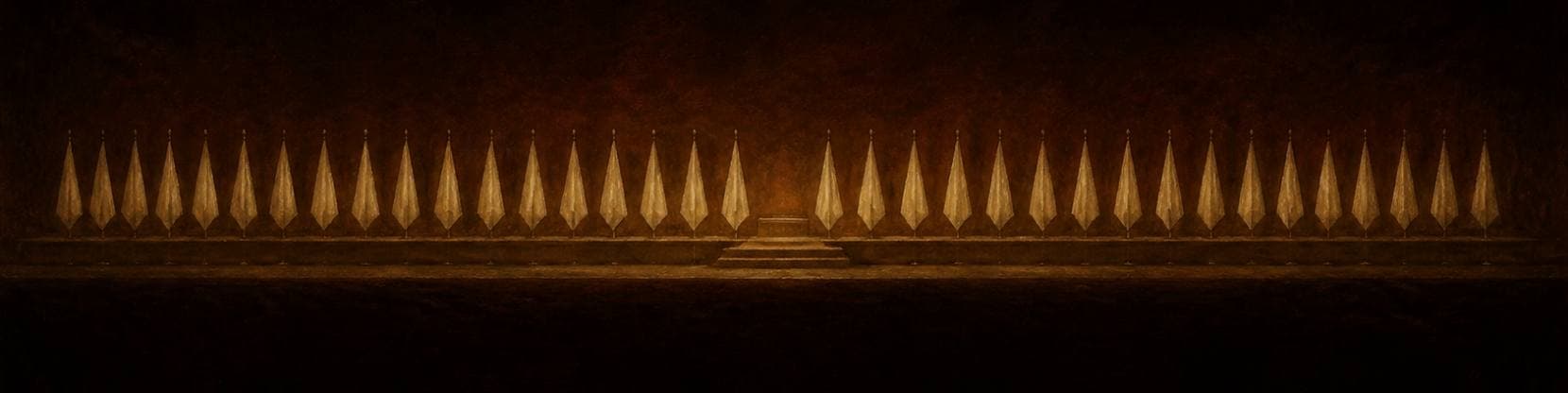
October 1956
The London Congress on Human Problems
12 lectures
From the 5th through the 8th of October 1956, L. Ron Hubbard convened the London Congress on Human Problems at the Royal Festival Hall on London's South Bank — the first congress he had ever held outside the United States. The flags of twenty nations stood ranged across the platform, an apt emblem for a congress whose stated subject was nothing narrower than the problems of Man himself. Britain was then a decade into its slow recovery from the war, and the wider world stood under the shadow of the hydrogen bomb; Hubbard, who had spent much of 1956 working between Washington and London and had established a research centre in Dublin expressly to test the broad-scale application of Scientology beyond the auditing room, chose this moment to demonstrate that the subject was ready for use on problems of any magnitude.
The congress belongs to the high period of 1956 simplification. Scientology: The Fundamentals of Thought, distilling the Axioms and the theory of games into their most compact statement, had only recently been issued, and The Problems of Work — written aboard ship on the voyage to England — was released to delegates at this very event. Where earlier congresses had largely addressed the auditor and the preclear, this one turned the subject outward toward the third and fourth dynamics: the school, the workplace, the nation, and the contest of nations. Its premise was that the seemingly immovable difficulties of the age yield to the same simplicities that resolve a single case — communication, problems, games, havingness — applied at scale.
Across the twelve lectures a listener follows that argument from foundation to application. The opening lecture, Man's Relentless Search, surveys Man's long pursuit of truth and locates precisely where each earlier philosophy and science lost the trail that Scientology recovered. Portions of You and Uses of Scientology lay out the anatomy of beingness and the range of the subject's workability; Youth — Today's Displaced Person takes up the education and condition of the postwar generation; Salvation 1956 and Personal Efficiency present the practical route outward, the latter introducing the Personnel Efficiency Course by which any Scientologist or group could deliver fundamental processing and instruction to the public at large. The final day carries the theme to its furthest reach: March of the Atom and Today's Battle of Britain confront atomic radiation and the standoff of the great powers, with Hubbard taking the position that a subject able to restore sanity to the individual is honor-bound to bring what influence it can against the destruction of Earth itself.
The congress also preserves the participatory character of the period: interleaved among the lectures are group processing sessions in which Hubbard runs the assembled delegates on processes of the era — putting the MEST universe there, keeping objects from going away, granting life — so that the audience did not merely hear about havingness and problems but handled them directly in session. Before the close, the delegates voted to petition world leaders for an impartial investigation of healing results and for attention to atmospheric radiation. Taken whole, the London Congress on Human Problems records the moment Scientology formally presented itself to the Eastern Hemisphere as a workable technology for living — confident, plainly stated, and aimed at every dynamic from the individual at his job to the survival of the planet.

October–December 1956
The Organizational Series Lectures
16 lectures
In the autumn of 1956, L. Ron Hubbard was back in Washington, D.C., conducting the 15th American Advanced Clinical Course at 1812 19th Street, beside the Founding Church of Scientology. While the ACC occupied the days, he reserved the evenings for a different audience and a different subject. Weekly, from October 18 through December 13, 1956, he addressed the staff and Academy students of the Founding Church — joined by the ACC students themselves — on the principles of organization and the practical machinery of delivering Scientology to the public. These evening talks became known as the Organization Series, catalogued in later years as the Washington Lectures on Organization and Personnel Efficiency.
The moment matters. Nineteen fifty-six was the year Scientology turned decisively toward the workaday world. Earlier that year in Dublin, Hubbard had codified the Personnel Efficiency Course as the route by which a working person could first encounter the subject; that fall he released both Scientology: The Fundamentals of Thought and The Problems of Work, and he had just delivered the London Congress on Human Problems before crossing the Atlantic. The question before the movement was no longer solely how to audit a preclear, but how a group survives, prospers and expands — how an organization becomes a stable dissemination point rather than a bottleneck. The Organization Series is his direct answer, delivered to the very people who had to run one.
Across the series the practical and the fundamental alternate. The opening evenings take up the creation and instruction of a Personnel Efficiency Course in concrete detail, then widen into education and the methods of education, the handling of audiences, testing, and the Tone Scale as he was applying it that autumn. At the center of the series sit the lectures on organization proper — a two-part examination of what an organization actually is, followed by an account of its consequences — in which Hubbard treats organization not as administrative convention but as a subject with its own anatomy: terminals, communication lines, and the reasons groups clog, falter or endure. Heard now, these evenings stand as his earliest extended lecture treatment of organization in its own right, anticipating by more than a decade the administrative technology he would later develop in full.
Interleaved with this instruction are addresses of remarkable range, several of which became celebrated on their own: Hope, with its anatomy of why beings cease to reach; The Scale of Havingness, applying that gradient to case and to life; Money, examined as an idea rather than a commodity; The Deterioration of Liberty, on how personal freedom erodes; A Postulate Out of a Golden Age, taking Pericles and the Athenian ideal as its point of departure; and Confusion and the Stable Datum together with Randomity, presenting the doctrine that underlies The Problems of Work — that any confusion resolves when one datum is held stable against it. A research report on radiation, reflecting the investigation that would surface in print the following year, rounds out the picture of where his attention stood as 1956 closed.
What the listener encounters, then, is a founder speaking plainly to his own staff at the close of a pivotal year: half working briefing, half statement of purpose, with the fundamentals of the subject — havingness, the stable datum, the conditions of games and groups — brought to bear on the unglamorous business of keeping the doors open and the public reached. For students of the administrative side of the subject, the series is where that line of thought first takes sustained, spoken form.

December 1956
Congress On Anti-Radiation And Confront Lectures
13 lectures
In the closing days of December 1956, L. Ron Hubbard called Scientologists to Washington, D.C. on short notice for what was announced as an emergency congress. Convening on Sunday, 29 December 1956 in the Hall of Nations of the Hotel Washington — on Pennsylvania Avenue, within sight of the White House — the Congress on Anti-Radiation and Confront ran through New Year's Eve, closing out the most heavily scheduled lecture year of the decade. The occasion was unmistakably of its moment: the Cold War was intensifying, American and Soviet atmospheric bomb tests were ongoing, and fallout counts had become a routine feature of the daily newspapers, even as public discussion of what radiation actually did to people remained scarce.
What brought the congress into being, however, was not the headlines but an observation from the auditing chair. Hubbard had noted a correlation between the rising radiation count in the atmosphere and an increasing difficulty of cases since 1950 — and not merely in proximity to test sites, but broadly, wherever auditing was being delivered. His address to the congress took up radiation as something more than a physicist's particle problem: an aberrative factor woven through practically every incident on the whole track, restimulated by the present-time atmosphere of the atomic age. Across the lectures he lays out the Scientology view of radiation, the question of proofing up a body against it, and his research into nicotinic acid — niacin — and the vitamin compound he called Dianazene, with its striking tendency to flush the body red in the exact pattern of past sunburns. Students of the later Purification Rundown will recognize in this material the early roots of that line of research.
The deeper technical yield of the congress lies in the second half of its title. The answer to radiation, as Hubbard frames it here, is the answer to any overwhelming force: the ability to confront. The lectures on confrontingness, together with those on the Scale of Havingness, the subzero scales and their relation to the scale of awareness, mark the emergence of confront as a foundational concept in its own right — one that would shape the training drills, the CCH processes and much of the technical development of 1957 and after. Alongside these come a lecture on the solution to psychosis, an examination of insanity in terms of scarcity and importances, and the announcement of Project Third Dynamic, a program for carrying the answers of Scientology outward into a society visibly unequipped to face its own weapons.
Across the thirteen lectures of this congress the listener encounters Hubbard working in both of his congress registers: the platform lecturer surveying a civilization's predicament, and the group auditor putting the assembled congress delegates through processing sessions — Put It There, Confrontingness, Mocking Up Bodies, Making Problems and Confusions — so that the theory of havingness and confront was not merely described but run. The congress sits at a hinge point in the chronology: it gathers up the havingness and games research of 1956 and points it directly at the developments of the new year, with the 16th American Advanced Clinical Course opening at the Founding Church in Washington just two days later, and the radiation line itself carried forward to the London Congress on Nuclear Radiation, Control and Health in April 1957 and the book All About Radiation.
1956
The Games Congress Lectures
13 lectures
Over the Labor Day holiday weekend beginning 31 August 1956, L. Ron Hubbard convened the Games Congress in the Main Ballroom of the Shoreham Hotel in Washington, D.C. It was, by the accounts of the time, the largest assembly of Scientologists yet gathered in one place — more than four hundred attendees, enough to outgrow the rooms that had housed earlier congresses. As with every congress of the period, the occasion was Hubbard's chosen platform for presenting a year's research directly to the field, and the research he brought to Washington that weekend was the culmination of his work on games: the proposition that, having surveyed hundreds of potential patterns by which life might be organized, the one that resolved them all was that life is a game.
The congress falls at a pivotal juncture in the chronology of the subject. The Founding Church of Scientology had been established in Washington the previous year, and through 1956 games theory had become the dominant line of Hubbard's research and the backbone of the Advanced Clinical Courses he was then delivering. The Games Congress carried that research to the broad public of Scientologists for the first time, and it did so alongside a landmark publication: the first edition of Scientology: The Fundamentals of Thought was released at this congress — the book Hubbard would later designate "Book One of Scientology." The lectures and the book thus stand together, the spoken and written record of the same body of discovery.
Across the thirteen lectures, Hubbard lays out the anatomy of a game with considerable precision. A game, he demonstrates, consists of freedom, barriers and purposes, and from that deceptively simple formula he derives the exact conditions that constitute a game — identities, opponents, attention, motion — and the conditions that constitute no game at all, such as solutions, serenity and no-motion. He examines control in terms of its component parts of start, change and stop, distinguishes four types of games including those a being plays without knowing he is playing them, and extends the analysis outward from the individual to groups and whole societies. Underlying all of it is a finding of direct consequence to the auditor: that a thetan does not actually want freedom from all problems, but seeks problems, and that aberration itself traces to games and games conditions gone out of the preclear's knowing control.
What the listener encounters, then, is not an abstract exercise in classification but a working explanation of why beings behave as they do — why a preclear clings to his difficulties, why solutions long since won can be as aberrative as problems never solved, and why processing succeeds to the degree it restores a being's ability to play a game knowingly and at will. Hubbard moves through the material with the informality characteristic of the congresses, building from first principles to direct application in auditing, and connecting the whole subject of games to the larger pursuit of truth that Scientology had been engaged in from the start.
For the student tracing the development of the subject, the Games Congress occupies a clear position: it is the public consolidation of the 1956 games research, the bridge between the Axioms-era foundations and the practical technology of problems, control and havingness that would occupy the years immediately following, and the moment Fundamentals of Thought entered the world. The thirteen lectures preserved here are the fullest spoken account of that moment.

1956
The Professional Course Lectures
22 lectures
The Professional Course Lectures were recorded by L. Ron Hubbard in London in August 1956, in a form unusual within the lecture canon: a deliberate series of half-hour talks, each confined to a single fundamental of Scientology and carried through until that subject stands complete on its own. Where the Advanced Clinical Course lectures of the period run long and range widely before a live student body, these were made as a standard teaching instrument — a spoken curriculum for the professional training courses Hubbard had set running on both sides of the Atlantic, in London and in Washington, DC.
The occasion belongs to one of the great consolidating moments of the subject. In mid-1956 Hubbard had just completed Scientology: The Fundamentals of Thought, conceived as the Book One of Scientology — a summary of the whole subject compact enough to introduce it to anyone, anywhere, in any language. The Professional Course Lectures are the spoken counterpart to that effort, made for the auditor rather than the newcomer. Their purpose was to produce Scientologists who not only could run a session but understood each principle well enough to teach it: the why behind it, where it came from in the research line, and the mechanics of its operation. Together with the book, the series marks the point at which six years of development since Dianetics was deliberately distilled into a stable, transmissible core.
Across the series the listener moves through that core one piece at a time. The opening lectures take up the codes governing the practice — the Auditor's Code and the Code of a Scientologist — and the first ten Axioms, the postulates on which the rest of the subject is built. From there the lectures anatomize the working tools of mid-fifties auditing: the anatomy of control and its components of start, change and stop; the structure of problems and how they are handled; confusion and the stable datum; games theory, then at the height of its development in processing; Opening Procedure of 8-C; exteriorization and its procedures; valences; chronic somatics; and, closing the arc, auditing itself considered as a profession.
What distinguishes the series is its discipline of form. Each talk holds to one subject at a steady gradient, so that a student can take the lectures in order and assemble, half hour by half hour, a complete working map of Scientology as it stood in 1956 — Axioms, scales, codes, basic processes, and their application to life beyond the session. The canonical set was issued as twenty-one lectures. For the student of the materials, the series occupies a particular place: it is Hubbard's own summation of the subject at the threshold of the late-fifties expansion, delivered not as exploration but as settled instruction, and it remains one of the clearest single statements of the fundamentals on which everything afterward was built.
Hearing these lectures
The 1956 recordings are held in the AOGP Lecture Library, which opens with an AOGP membership. Full catalogue access begins at the Foundation tier; Inner Circle adds the karaoke-style transcript reader with AI word clearing by Axiom AI. Membership starts with a free 14-day trial.
Find Out Where You Stand
For Independent Dianetics and Independent Scientology study, the lectures describe what the mind is doing. The free personality test shows you where you are on it — and Axiom AI can answer what you run into as you read.