Scientology Outside of the Church · Podcast
Own the Right Loops: Subsets Epilogue — Independent Scientology
1:39:08
About this episode
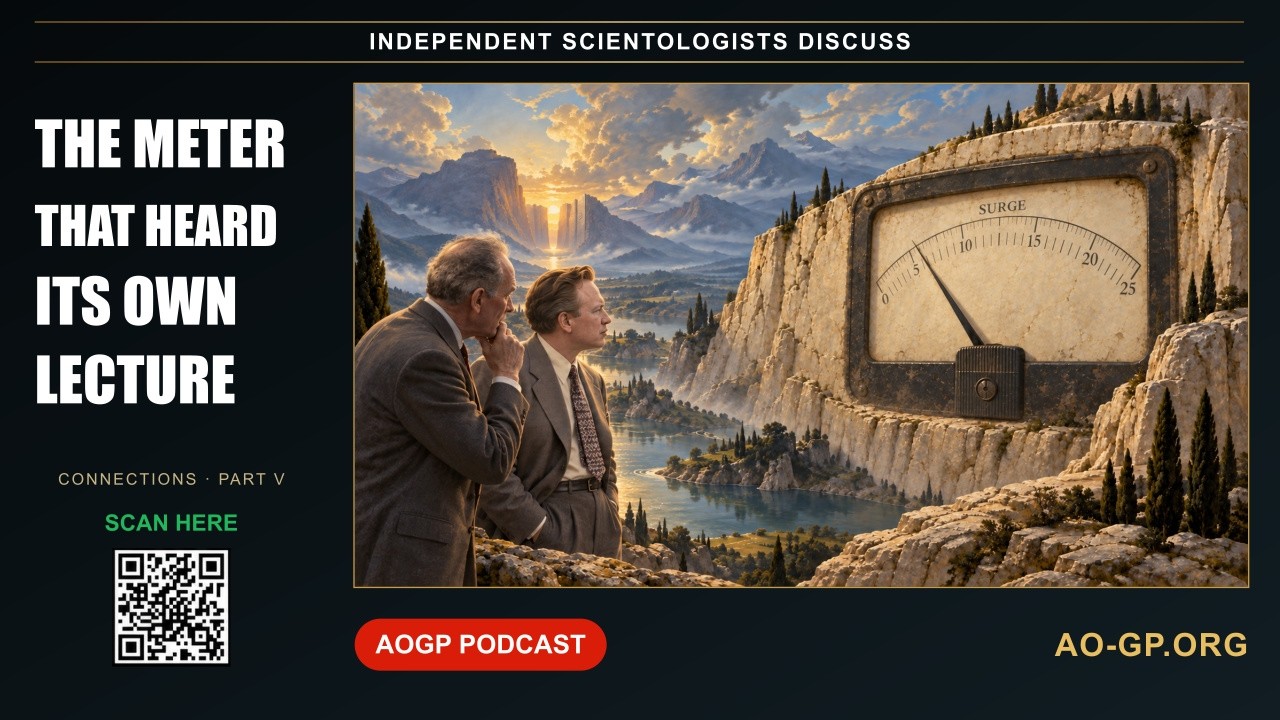
Check Out Axiom AI for yourself: https://www.ao-gp.org/axiom-ai Take our Incredibly detailed personality test!: https://www.ao-gp.org/personality-test Every life contains repetition, but repetition does not always produce the same result. Jonathan, Simphiwe, and Quenton close the Subsets series by setting its architecture in motion and asking the question beneath every recurring argument, practice, habit, business cycle, and attempt at change: do you own the loop, or does the loop own you? One man repeats the same argument with his brother for nine years and leaves each pass with less relationship than before; across town, a woman repeats scales at the piano and becomes more able every evening. Both are loops. One consumes the person inside it, while the other builds the person who chose it. That contrast turns six earlier episodes—machines, breakfast, organizations, misunderstood words, two ladders, and one room—into a single living test. Nobody gets a life without loops. The real choice is whether each return raises the platform for the next pass or quietly takes more away. The discussion follows the unowned loop into the reactive mind: recordings that replay when the environment presses the button, the overt-motivator sequence that manufactures the justification for its next turn, and the service facsimile that keeps applying one old solution long after it stopped serving survival. From there, the episode makes a sharper distinction between data and knowledge. A person can memorize a geometry book and remain unable to use geometry; someone who can control a clutch under pressure possesses a different kind of certainty. That same distinction opens an unexpectedly current comparison with artificial intelligence. A language model predicts the next probable answer, while a valence reproduces the surface of an identity that seemed to win before. Jonathan’s recent struggle with a coding model, Quenton’s business examples, and Simphiwe’s apprentice who can repeat the master’s answer without understanding the reason all expose the same failure: a copy can preserve the output while leaving the certainty behind. The comparison is structural, not a claim that a machine possesses a human mind. The way out begins with something held still. Axiom 53 says a stable datum is necessary for the alignment and order of data; confusion is not necessarily handled by adding more information, because more data without an anchor can make the spiral tighter. The episode connects that principle to the dwindling spiral of affinity, reality, communication, and understanding, and to the Data Series definition of sanity as the ability to recognize differences, similarities, and identities. An owned loop moves in the other direction: complete the cycle, flatten what was started, hold the gradient, and let each finished pass raise the next platform. Auditing repeats an action so it can finish; the reactive mind repeats because it never does. Jonathan, Simphiwe, and Quenton bring that distinction to Clear as recovered authorship and then return it to one practical observation. Choose one repeating situation and measure it after every pass: more ability, affinity, reach, and certainty—or less? Do not promise to stop the whole loop. Own one pass of it. The direction can change before the state arrives. ARTWORK Original artwork inspired by M.C. Escher’s continuous surfaces and visual infinity; not a copy of an Escher work. LRH REFERENCES CITED IN THIS EPISODE • “The Parts of the Mind” (6101C21-02); “The Tone Arm and the Service Facsimile” (SHSBC-329) • “General Lecture—Straightwire”; “Basic Theory of Definitions”; “State of Case” (6ACC-76); “Axiom 53—The Axiom of the Stable Datum” • Data Series 1R, “The Anatomy of Thought”; “Data of Comparable Magnitude—Part I”; “Rightness and Wrongness” (SHSBC-328) • “Flattening a Process” (SHSBC-374); “Logics 1–7” (5211C10B); “The Magic Button”; “ACC Command Sheet—Goals of Auditing” (5807C28) AI COLLABORATION DISCLOSURE The speaking-point structure and production materials used disclosed AI collaboration; the recorded viewpoints and examples are Jonathan’s, Simphiwe’s, and Quenton’s. EXPLORE INDEPENDENT SCIENTOLOGY AOGP: https://www.ao-gp.org/ Axiom AI: https://www.ao-gp.org/axiom-ai Personality Test: https://www.ao-gp.org/personality-test #IndependentScientology #Scientology #LRH